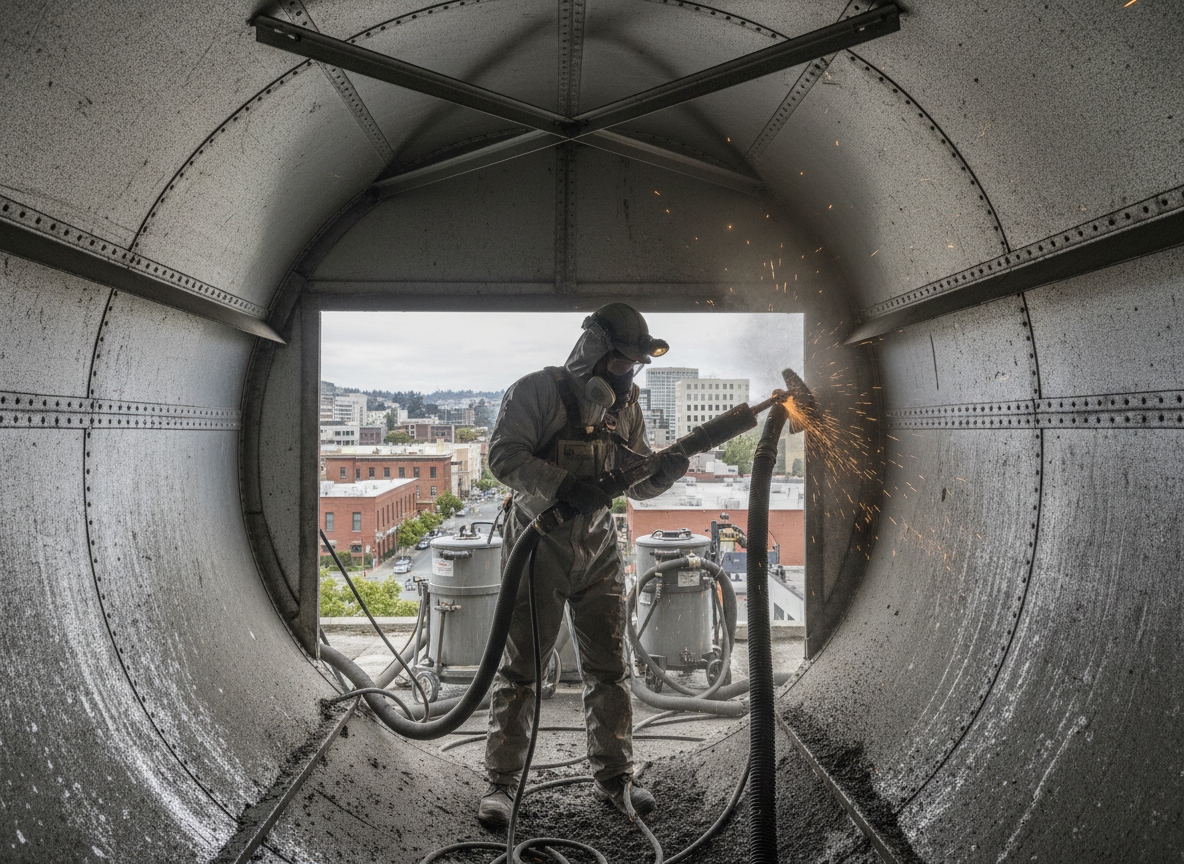
Industrial air duct systems in the Berkeley area often run through older manufacturing and warehouse buildings where years of metal shavings, chemical residues, and fine dust accumulate in long horizontal runs and large plenums. These systems require negative-air machines with higher CFM ratings than residential equipment because the duct diameters are bigger and the contamination layers are thicker. Technicians must map each trunk line before starting so that sections can be isolated without shutting down an entire facility.
Berkeley Heights sits near former industrial corridors where soil vibration from nearby rail lines and seasonal freeze-thaw cycles loosen joints and create small gaps. Those gaps allow outside particulates to re-enter after cleaning if seals are not replaced. Crews carry gasket material and mastic on every job because standard foil tape fails quickly in the temperature swings common to unconditioned warehouse spaces.
Access panels must be cut into rigid metal ducts without compromising structural integrity or fire ratings. Local building departments require permits for any penetration that affects fire dampers, so the crew documents every opening and reinstalls panels with matching gauge metal. Skipping this step risks failed inspections when the building changes hands.
After the mechanical cleaning, a final HEPA vacuum pass removes residual debris that would otherwise circulate when the system restarts. In industrial settings this final step often takes longer than the agitation phase because of the volume of material collected in the lower sections of vertical risers.
Technician insight
In Berkeley the thing that catches most people out with Industrial air duct cleaning is the fine metal dust that settles in the lower elbows of older warehouse systems near the former rail spurs; once disturbed it travels farther than expected and requires an extra containment stage that residential crews never plan for.
Warehouse duct blockage near Berkeley Heights rail line
A distribution building reported reduced airflow in its paint-booth exhaust system. Inspection found compacted metal particles and insulation fragments lodged in two 24-inch elbows. The crew isolated the affected runs, used extended rotary brushes to break up the blockage, and vacuumed the material without shutting down adjacent shipping operations. Airflow returned to original specifications once the lines were cleared.
How it works
- 1
Site Assessment
Technicians inspect every accessible section of the industrial ductwork, note damper locations, and measure airflow to determine the correct equipment size for the job.
- 2
Isolation and Containment
Sections are isolated with temporary barriers so negative pressure can be maintained without affecting production areas or other occupied spaces in the building.
- 3
Mechanical Agitation
Rotary brushes and compressed-air whips dislodge built-up material while the vacuum system pulls debris into sealed collection units.
- 4
Final Cleaning and Verification
Remaining surfaces are vacuumed and the system is run to confirm airflow has returned to design specifications before panels are resealed.
Pricing
Cost depends on total linear footage, number of vertical risers, and whether production must continue during work.