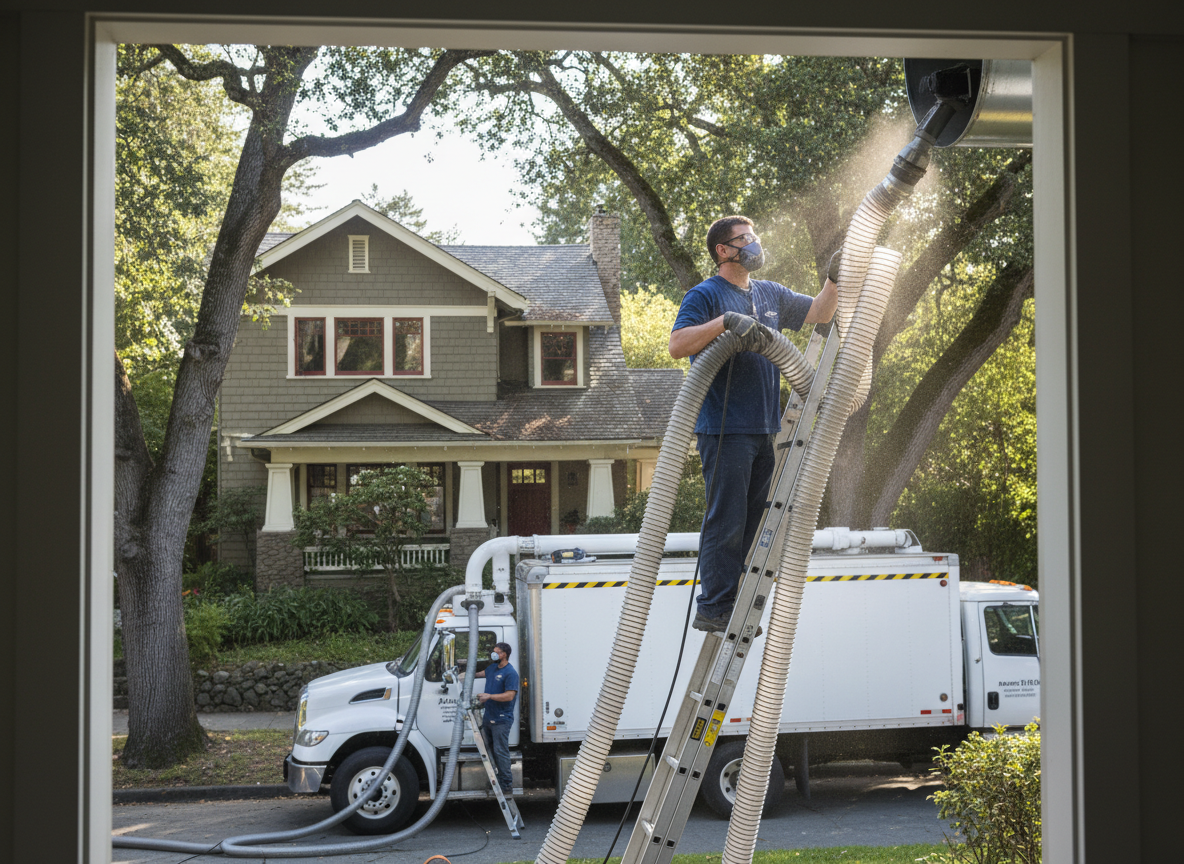
Whole house air duct cleaning in Berkeley Heights addresses the buildup common in homes built from the 1950s onward along Snyder Avenue and surrounding streets. Older ductwork often runs through basements or crawl spaces where moisture from seasonal humidity mixes with construction dust and pollen carried in from nearby wooded sections of Union County. Technicians use negative-pressure equipment to reach branch lines without disturbing insulation or drywall in finished areas.
Edge cases arise when homes have flexible duct sections added during renovations in the 1980s or 1990s. These runs can sag or collect debris that rigid metal ducts do not. In Berkeley Heights, where many properties sit on slight slopes, condensate from air handlers can travel farther than expected and create hidden mold spots at low points. Cleaning crews check every accessible register and return to confirm no residue remains before sealing access points.
Homeowners sometimes attempt partial cleaning with shop vacuums or brushes that only reach the first few feet. This leaves deeper sections untouched and can push debris further into the system. Revexa Core starts at the main trunk and works outward, using brushes sized for each duct diameter to avoid punctures in older sheet-metal seams common in the neighborhood.
After cleaning, registers are wiped and reinstalled, and the system is run to verify airflow. This step reveals any remaining restrictions that would otherwise go unnoticed until heating or cooling season begins.
Technician insight
In Berkeley Heights the thing that catches most people out with whole house air duct cleaning is the number of homes where 1980s additions added flexible duct runs that sag behind finished ceilings. Those low spots collect condensate and pollen from the nearby wooded edges of Union County far more than the original rigid lines, and a standard trunk-only cleaning misses them entirely.
Snyder Avenue Split-Level Home
Homeowners noticed reduced airflow from several second-floor registers after a wet spring. Inspection found compacted dust and minor moisture staining in a flexible duct section added during a 1990s renovation. Crews isolated the run, agitated and extracted the material under negative pressure, then verified restored airflow at every register before leaving.
How it works
- 1
Initial Inspection
Technicians arrive at the Berkeley Heights address and examine accessible ducts, registers, and the air handler to note any visible debris, moisture, or damage before starting equipment setup.
- 2
System Isolation
Vents and returns are sealed to create negative pressure throughout the trunk lines and branches, preventing dust from escaping into living spaces during agitation.
- 3
Agitation and Extraction
Rotating brushes and compressed air tools loosen debris while a HEPA-filtered vacuum pulls material from the main trunk outward to the farthest branches.
- 4
Final Verification
All registers are cleaned, the system is restarted, and airflow is checked at multiple points to confirm the ducts are clear before departure.
Pricing
Cost depends on the number of stories, total linear feet of duct, and whether flexible sections or moisture issues are present.